
-
Mono-and Diglycerides of Fatty Acids Series Medium Chain Triglycerides/Octyl and Decyl Glycerate (MCT/ODO) Polyglycerol Esters of Fatty Acids (PGE) Polyglycerol Polyricinoleate (PGPR) Propylene Glycol Esters of Fatty Acids Capryl Monoglyceride Hydrocolloid Series Bakery Emulsifier Series Compound Emulsifier Series Compound Emulsifier and Thickener Series
Glyceryl Monocaprate: The "Invisible Guardian" of Food Preservation and Texture Enhancement
Sep 17,2025
Under the food industry's dual pursuit of safety and quality, Glyceryl Monocaprate Capryl monoglyceride, as a highly effective and versatile food additive, is becoming an indispensable component in modern food engineering. This pale yellow, transparent liquid is odorless yet carries a subtle coconut-like aroma, quietly delivering its triple benefits—preservation, emulsification, and stabilization—in foods such as bean paste fillings, pastries, and meat products.
I. Why Choose Glyceryl Monocaprate: Scientific Properties and Application Advantages
The core value of glyceryl monolaurate lies in its "Broad-Spectrum Antibacterial" and "Dual Function" Features:
- Efficient corrosion protection without limits : Effectively inhibits Gram-negative bacteria, molds, and yeasts; Japan designated it as a "…" in the 1980s. Unlimited-use preservative “FAO/WHO’s JECFA has also not set an ADI value for it.
- Emulsification-Stabilization Two-in-One As a lipophilic non-ionic emulsifier (HLB value of 5.2), it effectively prevents oil-water separation while enhancing the anti-aging properties of starch, making it particularly outstanding in food products containing oils, pigments, or flavorings.
- Use compliantly for greater peace of mind :
According to the national standard GB 2760-2024, its scope of application and usage levels are clearly defined and controllable: - Pastry and Cake Products (Noodles, mooncakes, cakes, etc.): ≤1.0 g/kg
- Meat Sausage Products (Sausages, ham sausages, etc.): ≤0.5 g/kg
- Bean paste : ≤1.0 g/kg
II. Practical Applications of Glyceryl Monocaprate in the Food Industry
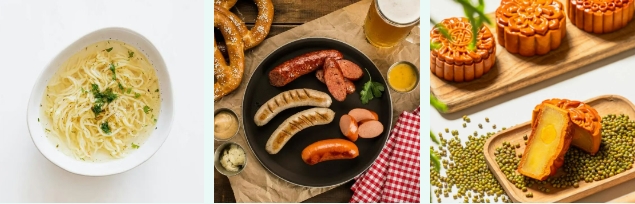
- Pioneer in Anti-Aging for Flour and Noodle Products
Adding 0.5–1.0 g/kg to fresh wet noodle products can significantly delay starch retrogradation, making the noodles more resistant to overcooking and the dumpling wrappers more flexible. When used in pastries, it helps lock in moisture, preventing hardening and extending the shelf life to over 30 days. - The "Freshness Guardian" of Meat Products
Adding just 0.5 g/kg of meat-based sausages can inhibit lactic acid bacteria and molds, extending the shelf life by 40% in high-temperature, high-humidity environments—while also enhancing fat emulsification and improving sliceability and taste. - The reliable tool for stabilizing fillings
To prevent oil separation in the bean paste and impart a delicate, smooth texture.
III. Professional Expertise as a Safeguard: Kaiwen Group’s Innovative Practices
On the path to upgrading the quality of additives such as caprylic/capric triglyceride, Kaiwen Group Leveraging 20 years of technological expertise, we have become an industry benchmark and established a comprehensive system spanning R&D, production, and application.
Kaiwen Group manufactures high-quality monoglyceride caprylate in-house, and its products are certified through "Raw Materials - Process - Finished Products" Triple Quality Control , ensuring comprehensive compliance—from anti-corrosion performance to emulsion stability.
IV. Future Outlook: A Dual Track Approach of Security and Innovation
As consumer demand for "clean labels" and healthy foods continues to grow, glycerol monocaprate stands out due to its Natural source (coconut oil derivative)  toЈ Metabolic Safety , making it an ideal alternative to chemical preservatives such as sodium benzoate.
"The value of scientific additives lies in..." Invisible protection, visible enhancement “In Kaiwen’s practical philosophy, safety and efficacy have never been a matter of either/or. From the smooth, long-lasting preservation of mooncake fillings to the enhanced elasticity of sausage products, monoglyceride of caprylic acid is reshaping the food industry’s approach to freshness—with its “minimal dosage, maximum effectiveness” properties. And Kaiwen Group Thanks to scalable production and rigorous quality control, this ingredient strikes the perfect balance between safety and functionality—after all, innovation in the future of food always begins with a deep respect for every single gram added.




No.19, Jinhui Road, Zengcheng, Guangzhou
Copyright © 2025 Guangzhou Kevin Food Development Co., Ltd. All Rights Reserved